

Navigating Conflicting Data Privacy Obligations: Israel, the U.S., and the EU
For companies operating across borders, privacy compliance is no longer a box-ticking exercise—it is a live negotiation between competing regimes. An Israeli company serving U.S. users through a U.K. cloud provider, for example, sits at the crossroads of three demanding frameworks: Israel’s Privacy Protection Law (Amendment 13), Maryland’s MODPA, and the EU’s GDPR. Each law imposes its own priorities, penalties, and cultural approach to data governance. The result is a legal triangle where obligations overlap, diverge, and occasionally collide.
As a lawyer working with high-growth businesses, I see the same challenge arise repeatedly: how to honor competing regulatory demands without drowning in compliance overhead or paralyzing operations.
The Regulatory Landscape
-
Israel (Amendment 13): Imposes new obligations on transparency, record-keeping, sensitive data use, and enforcement exposure. It requires companies to elevate compliance into the boardroom.
-
United States (MODPA in Maryland): Adds state-level obligations in 2025, focusing on data minimization, children’s data, and new restrictions on targeted advertising.
-
European Union (GDPR): Continues to be the most influential privacy law globally, with strict consent regimes, cross-border transfer rules, and significant enforcement powers.
Overlay these with the U.S. CLOUD Act, which may compel a U.K. cloud provider to disclose data to American authorities even when GDPR or Israeli law would restrict such access, and the conflicts become real, not theoretical.
Strategic Compliance Triage
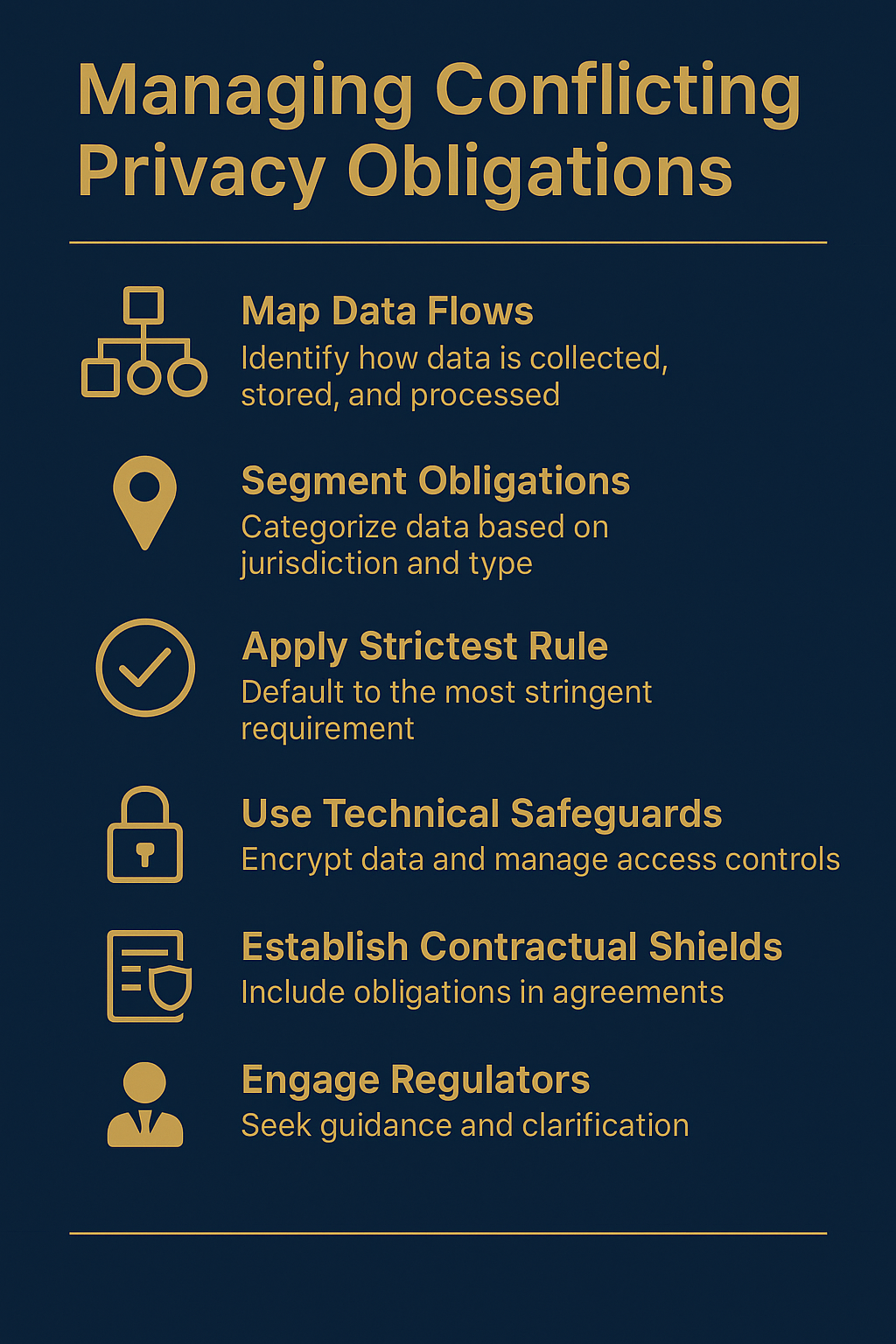
A multinational business cannot afford to treat these regimes as three parallel silos. Instead, it must adopt a triage framework:
-
Data Mapping as Foundation: You cannot reconcile laws you do not understand. Build a granular map of what data you collect, where it is processed, and under which jurisdiction it falls.
-
Segment by Origin and Risk: Apply differentiated rules to U.S. users, EU users, and Israeli users. Sensitive categories (children, health, financials) deserve heightened treatment across the board.
-
Apply the “Strictest Wins” Principle: When obligations conflict, lean toward the stricter standard. This may appear burdensome in the short term, but it creates legal defensibility and reputational resilience.
-
Technical Barriers to Legal Overreach: Encryption with keys held outside of high-risk jurisdictions, data localization, and access-control architectures provide insulation against conflicting demands such as CLOUD Act disclosures.
-
Contractual Safeguards: Embed obligations into processor and sub-processor contracts requiring notification of conflicting legal demands, with explicit escalation procedures.
-
Regulatory Engagement: Where ambiguity is unavoidable, proactive dialogue with regulators (or reliance on formal opinions) creates a defensible record if challenged.
Why It Matters for High-Level Business Decisions
Executives often underestimate the commercial risk of privacy conflict. The issue is not simply regulatory fines - it is operational paralysis, reputational loss, and erosion of investor confidence. A failure to anticipate the collision of these frameworks can stall product launches, disrupt fundraising, or derail cross-border M&A.
The most sophisticated businesses I work with treat privacy compliance as enterprise risk management, not as a compliance box to be delegated. They implement frameworks that balance operational flexibility with defensibility, so that when—not if—conflicting demands arise, they can demonstrate a reasoned and documented decision-making process.
Conclusion
Privacy law is not converging - it is fragmenting. For global companies, success depends on recognizing that compliance is not only about obeying rules but about building a resilient architecture for decision-making in the face of legal contradictions. The businesses that thrive will be those that treat conflicting privacy obligations as a strategic challenge to be managed, not as a peripheral legal problem.
Contact us to ensure your company's compliance with its privacy obligations.